
Quick answer: To read your propane tank gauge, lift the dome lid and look at the round dial underneath, where the needle shows how full the tank is as a percentage of its capacity rather than how many gallons remain. Order more propane once that needle reaches 30 percent, which leaves enough fuel in the tank to get through a normal delivery window.
Before you start
- What you need: nothing at all, because this is a two handed job that takes no tools.
- Time: about two minutes.
- Difficulty: easy, and anyone in the household can do it.
- Safety: this is only lifting a lid and reading a dial, so do not turn any valve, do not loosen any fitting, and do not open the small bleeder screw. At any smell of propane, leave the area and call from somewhere else.
Knowing your tank level is the difference between a routine delivery and a cold weekend, and the whole check takes about two minutes. Anyone new to propane at home will find the wider picture in our guide to home propane for Virginia homeowners.
How do you read a propane tank gauge?
1. Open the dome lid
Lift the hinged cover at one end of the tank. On an above ground tank that is the rounded hood at the end carrying the fittings, and on an underground tank it is the lid sitting flush with the lawn. Done right, the view underneath is a cluster of brass fittings and one round dial with numbers on it.
2. Find the round float gauge
Look for the dial marked from 5 to 95. It is usually the largest round face under the lid and it carries a needle much like a fuel gauge, while the other fittings are valves and connections that say nothing about the level. Federal rules on propane containers require a gauge of this kind, which is why every tank has one in roughly the same place, as set out in the OSHA standard for storage and handling of liquefied petroleum gases.
3. Read the needle as a percentage
Note the number the needle points to and treat it as a percentage rather than gallons. A needle resting on 40 means the tank is holding 40 percent of what it can hold. Done right, you have a single number you can report over the phone or compare against your last reading.
4. Convert the percentage into gallons
Multiply that percentage by the size of the tank. A 500 gallon tank reading 40 percent is holding roughly 200 gallons, and if you are unsure which size is in your yard, our guide to propane tank sizes covers how to tell. Done right, the gallon figure is what makes a reading comparable against how fast the household burns fuel.
5. Write the reading down with the date
Keep a note of your reading and the day you took it. Two readings a week apart give a burn rate, and a burn rate is the only reliable way to predict when the next delivery is needed. Done right, the household can say something like “we drop about four percent a week in January” instead of guessing.
6. Close the lid
Put the dome lid back down. The lid is what keeps rain, leaves and insects out of the fittings, so it should sit flat and latched when the check is finished.
What percentage means it is time to order?
Order at 30 percent, not at 10
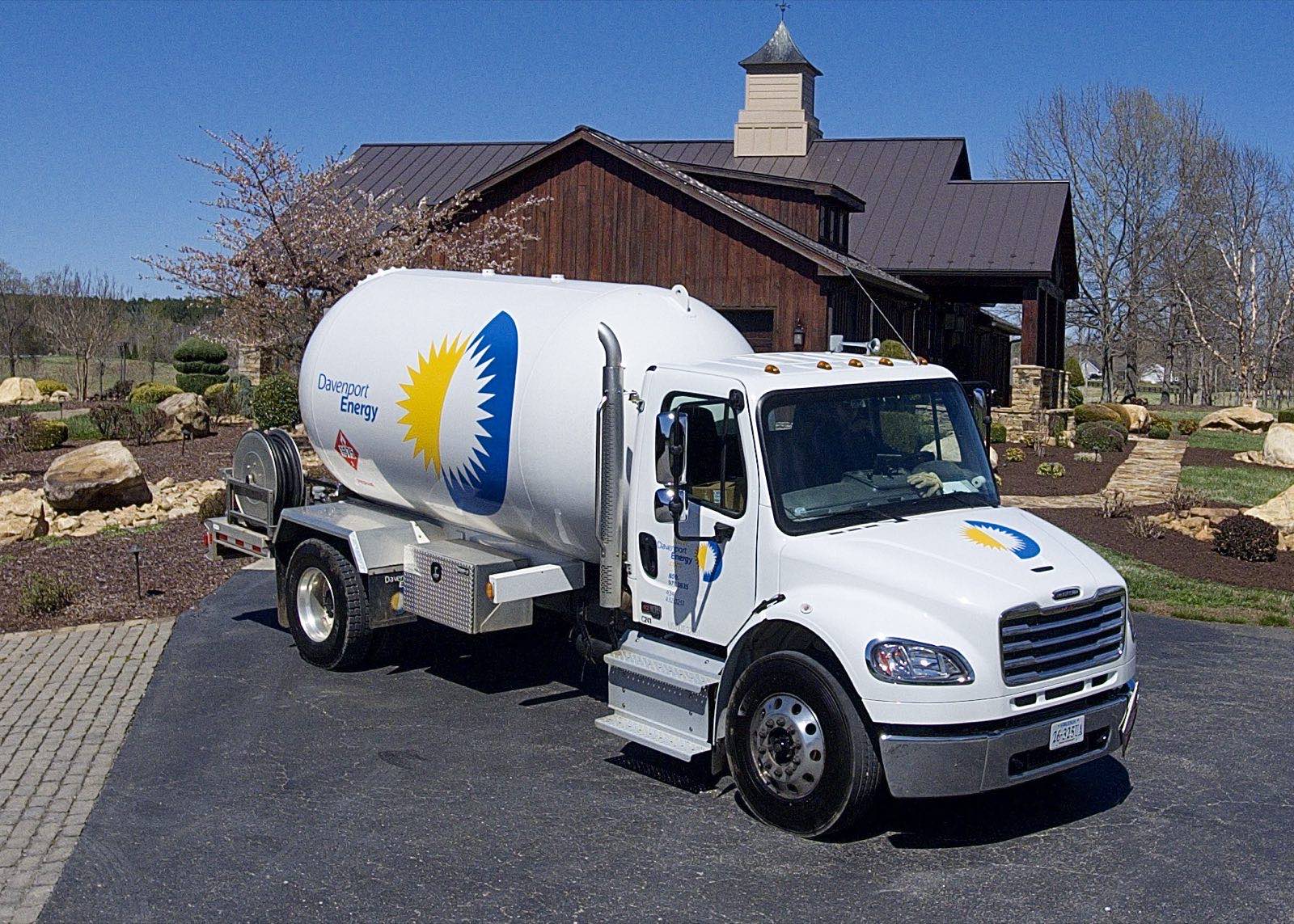
Thirty percent is the number we give our own Customers, and the reason is how deliveries actually run. We deliver on routes across Virginia and North Carolina rather than dispatching one truck per phone call, so a tank at 30 percent sits comfortably inside the next pass through its area.
Ordering at 30 percent means a normal delivery window is comfortably enough time. Waiting until 10 percent is what turns a routine fill into an emergency.
Why a tank is never filled to 100
A full delivery stops short of the top deliberately, because propane expands as it warms and the space above the liquid gives it somewhere to go on a hot day. Our drivers fill to that point on every tank, so a gauge sitting in the low 80s straight after a delivery is a full tank rather than a short fill.
Or stop reading the gauge altogether
Automatic Delivery takes the gauge off the to-do list entirely. We track usage and the weather and schedule the fill before the tank gets low, so there is nothing to remember and nothing to call in. Anyone weighing that against calling in their own orders will find the two compared in Automatic Delivery versus will-call.
When should you stop and call for help?
Close the lid and step away if any of these are true
Reading the gauge is a homeowner job, and anything beyond reading it is not. Close the lid and step back at any smell of propane, at frost or ice on the tank body, at a dial that is fogged, cracked or stuck, or at a needle that has not moved through weeks of cold weather.
Propane is the one case where the right move is to stop rather than investigate. Nothing under that lid should be tested, tightened or opened by hand, and a strong smell of gas means leaving the area first and calling from somewhere else.
What we can help with
Where the gauge reads normally and the number is simply low, that is a delivery, and a delivery is what we do. Call Davenport Energy at (800) 971-3835 with the reading in hand.
What are the most common mistakes?
Four to avoid
- Reading the number as gallons. A needle on 30 means 30 percent of capacity, which on a 500 gallon tank works out at roughly 150 gallons.
- Checking only once it turns cold. One reading gives a level, two readings give a burn rate, and only the burn rate predicts anything useful.
- Waiting for the tank to look empty. There is no outward sign of a low tank, which is the whole reason the gauge exists in the first place.
- Assuming a summer burn rate holds in January. A house burning four percent a month in July can burn that much in a single week during a cold snap.
Propane delivery across Virginia and North Carolina
Davenport Energy has delivered fuel across Virginia and North Carolina since 1941. Where a gauge is reading low, or where Automatic Delivery would be the easier answer, we will take it from there.
Davenport Energy, Inc.
120 S. Main Street, Chatham, VA 24531
Call: (434) 432-0251