
This guide covers home heating oil from the ground up: what it is, how it reaches your tank, how much a Virginia home goes through in a winter, what the tank itself needs from you, and what to do when something goes wrong. It is written for a homeowner who has just moved into an oil heated house, or who has lived in one for years and never had the whole picture in one place.
What is home heating oil?
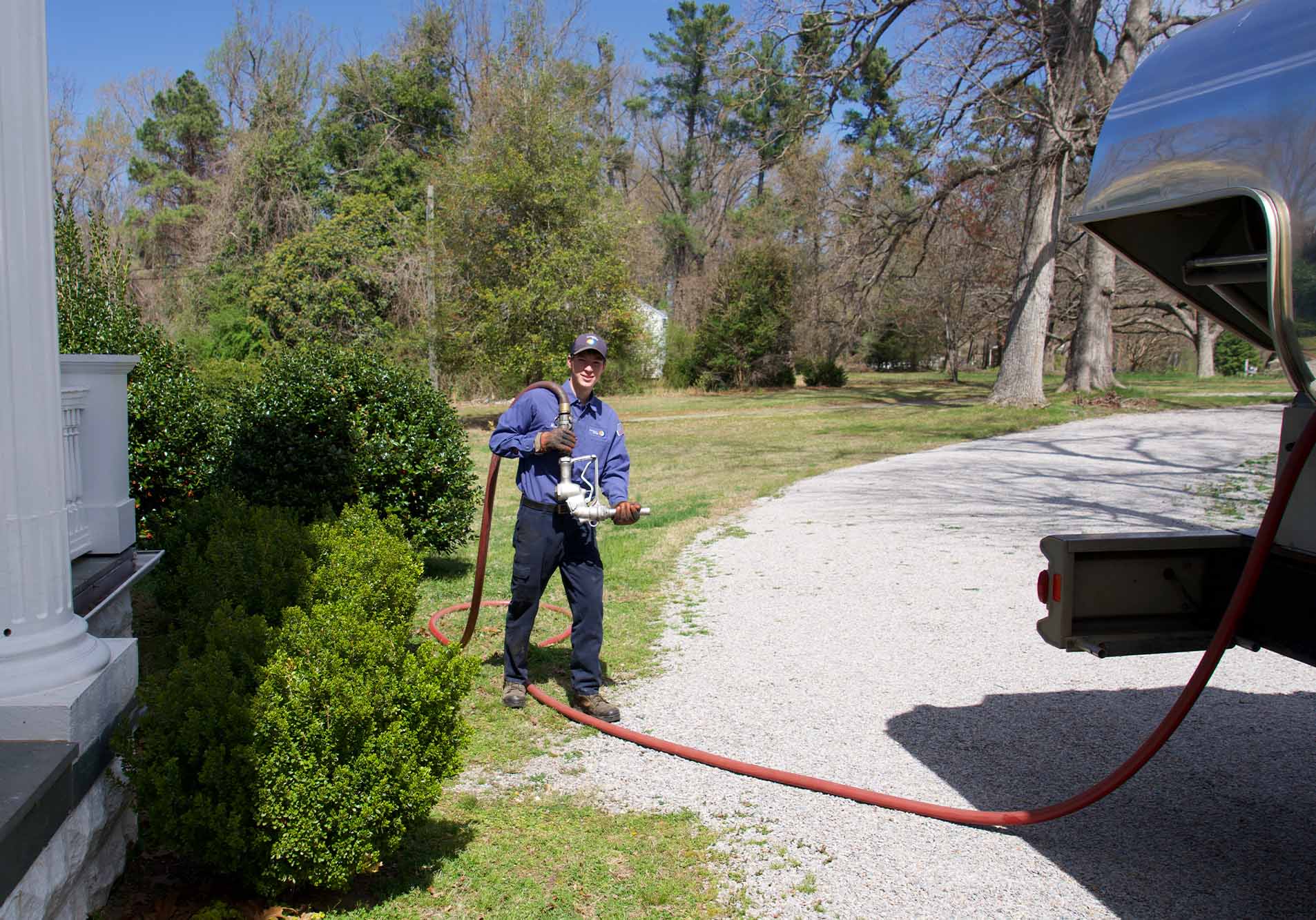
Heating oil is a liquid fuel stored in a tank at your home and burned to heat the house and, in many homes, the water. The tank sits in a basement, a garage, a crawl space or outside on a pad. A truck comes to you and fills it. You are not connected to a pipeline and there is no meter.
That is the whole arrangement. Everything else in this guide is detail on top of it: who decides when the truck comes, how you know where you stand, and what the tank needs so it lasts.
How does heating oil get to your home?
Two ways, and the choice shapes how much attention your heating takes through the winter.
Automatic Delivery
On Automatic Delivery we track how much you have used and how cold it has been, and we work out when you are due before you run low. Nobody at the house has to watch a gauge or remember to call. The longer you are with us, the better that estimate gets, because it is built from your own history rather than an average.
Will-call
On will-call you watch the gauge and you phone us. It puts the timing in your hands, which some people prefer, and it asks you to remember in January when the house is burning fuel fastest. Delivery runs on routes, so a few days of notice gets you a better window than a same day call.
What the driver needs on the day
A delivery goes faster and is far less likely to be missed when the fill pipe is easy to find and easy to reach. Keep the route from the driveway to the pipe clear of parked cars, bins, firewood and anything stacked against the wall over the summer. If the fill is behind a gate, unlock it. If a dog has the run of the yard, bring it in while the crew is working.
It takes a couple of minutes and it saves a wasted trip. A driver who cannot safely reach the pipe has to leave and come back, and in the middle of a cold week that second visit is a day neither of us planned for.
How much heating oil does a Virginia home use?
There is no single number, and anyone who gives you one without asking about your house is guessing. What drives it is how cold the winter turns out, how well the house holds heat, how big it is, how many people live there, and what temperature you keep it at.
The useful way to answer it for your own home is to write down the gauge reading and the date, then read it again a few weeks later. The drop between those two numbers is your real burn rate, and it beats any estimate made from outside. Once you know roughly what a season costs you, the next question is how to spread it, which we cover in how to budget for winter heating costs in Virginia.
If you want the background on the fuel itself rather than on your own house, the US Energy Information Administration publishes a plain explainer on where heating oil comes from and how households use it.
Can you lower what you burn?
Yes, and most of it is the house rather than the fuel. Heat escaping through an uninsulated attic, around windows and doors, or through a crawl space is heat you paid for. Thermostat habits matter too: a few degrees overnight across a whole winter adds up to real gallons.
None of that requires replacing anything expensive. The upgrades that actually move the number, and roughly what each one does, are in ten easy home upgrades that help reduce oil heating costs.
What size is your tank, and how do you read it?
Most homes in our area run a 275 gallon tank, the upright oval shape you will recognize in a basement or beside a garage. Larger houses and older installations sometimes carry 330 gallons, and outdoor and buried tanks come in a wider range again.
A tank never holds its full rated size
A 275 gallon tank is a 275 gallon shell, not 275 gallons of usable oil. Some depth at the bottom sits below the outlet and is never drawn, and a tank is not filled to the very top, so the working figure is lower than the number stamped on it. That is normal and it is not a short delivery.
The gauge reads fractions, not gallons
The float gauge on top reads in fractions of a tank: full, three quarters, a half, a quarter. So a 275 gallon tank showing a quarter is holding something in the region of 68 gallons, not 25 of anything. Reading it as a percentage of gallons is the single most common misreading we hear, and it is how a tank reaches a quarter with nobody concerned about it.
Check it monthly through the winter and weekly in a cold snap. Do not wait for the needle to sit on the bottom, because a delivery has to reach you and routes fill up fastest in exactly the week you would be calling.
What does your oil tank need from you?
The tank is the part of the system most homeowners never think about until it fails, and it is the part that quietly decides how long the whole arrangement lasts.
Corrosion starts on the inside
Tanks rarely rust through from the outside first. Condensation forms inside the tank as the temperature swings, water settles under the oil, and corrosion works outward from there. A tank kept fuller through the off season has less room for that air, and less condensation. What causes it and what to watch for is covered in how heat and moisture contribute to heating oil tank corrosion.
What you can see from outside
Look for weeping or staining at the seams and around the legs, any damp patch underneath, and rust that is flaking rather than surface powder. If you see any of that, it is a conversation to have before the next cold snap, not after.
What happens if you run out?
Running out is not simply an empty tank. When the oil is gone the burner draws air into the fuel line, and the system has to be restarted and bled by a qualified heating technician before it will run properly again. That is a service visit rather than a delivery, which is why running out costs more and takes longer than a fill.
Davenport delivers the fuel. The restart is equipment work and belongs to your heating service company. What to do in what order, from the moment you realize the tank is dry, is in what to do if you run out of heating oil this winter.
How do you get ready before the season?
The work that saves a winter happens in autumn, and almost none of it is difficult. Get the tank well up before the first hard night, clear the path the driver uses so a delivery is never a wasted trip, check that the fill and vent pipes are unobstructed, and know where your shutoff is in daylight rather than by torchlight.
The full list, in the order worth doing it, is in our fall fuel readiness checklist for Virginia homeowners.
Heating oil or propane?
If you are choosing rather than inheriting, the two fuels behave differently. Heating oil carries more heat per gallon, so a tank of it goes further on the heating side. Propane runs a wider range of appliances, including cooking, a dryer, a fireplace and outdoor equipment, and it is stored under pressure rather than as a liquid at atmospheric pressure.
Most homes do not switch on a whim, because the equipment is fuel specific and changing it is a real project. If you are weighing it anyway, the comparison is laid out in heating oil versus propane, which is right for your Virginia home. We deliver both, so the answer we give you is not a sales pitch for one of them.
Which delivery setup suits your household?
| If this sounds like your home | What we would suggest | Why |
|---|---|---|
| Heating oil is your only heat source | Automatic Delivery | Usage spikes exactly when you are least likely to be checking a gauge |
| You travel through the winter | Automatic Delivery | Nobody is at the house to read the tank or make the call |
| You have run out before | Automatic Delivery | A second runout means another restart visit on top of the fuel |
| You watch the tank closely and prefer control | Will-call | You decide the timing, and you accept the reminder is yours |
| Winter cash flow is the pressure | Automatic Delivery with Level Pay | Spreads the cost across the year rather than landing it in January |
| A second home or a rental | Automatic Delivery | An empty tank found in spring is a repair, not a delivery |
Frequently asked questions
How often will I get a delivery?
It depends on your tank size and how cold it has been, not on a fixed calendar. On Automatic Delivery we work the timing out from your own usage history, so the interval changes with the weather rather than staying the same all winter.
What is Level Pay?
Level Pay spreads your fuel cost into even monthly payments across the year instead of concentrating it in the coldest months. It does not change how much fuel you use, it changes when you pay for it.
Should I keep the tank full over the summer?
Keeping it well up through the off season leaves less room for the air that causes condensation inside the tank, and condensation is where internal corrosion starts. It is one of the cheapest things you can do for the life of the tank.
Does Davenport service my furnace or boiler?
No. We deliver the fuel. Equipment installation, maintenance and repair belong to a qualified heating service company, and that is who to call for a tune up, a breakdown or a restart after a runout.
How do I read my tank gauge?
Most oil tanks use a float gauge on top that reads in fractions rather than gallons, so a 275 gallon tank showing a quarter is holding roughly 68 gallons. Write the reading and the date down twice a few weeks apart and you will know your own burn rate.
What if I am not sure how much oil is left?
Call us. We would far rather look it up with you than have you find out on the coldest night of the year.
Davenport has delivered fuel across Virginia and North Carolina for generations, and we live and work in the same communities we serve. If you want a straight answer about your tank, your usage or your delivery setup, call us and we will give you one.
Keep reading
- How to read your heating oil tank gauge
- What size is your heating oil tank?
- How much heating oil does a Virginia home use in a winter?
Heating oil delivery across Southern Virginia and North Carolina
If you want a delivery schedule matched to how your household actually burns fuel, that is a short conversation. The phones are answered around the clock, and there is an office within reach of most of southern Virginia and northern North Carolina. We have delivered fuel here for generations, and we live and work in the same communities we serve.